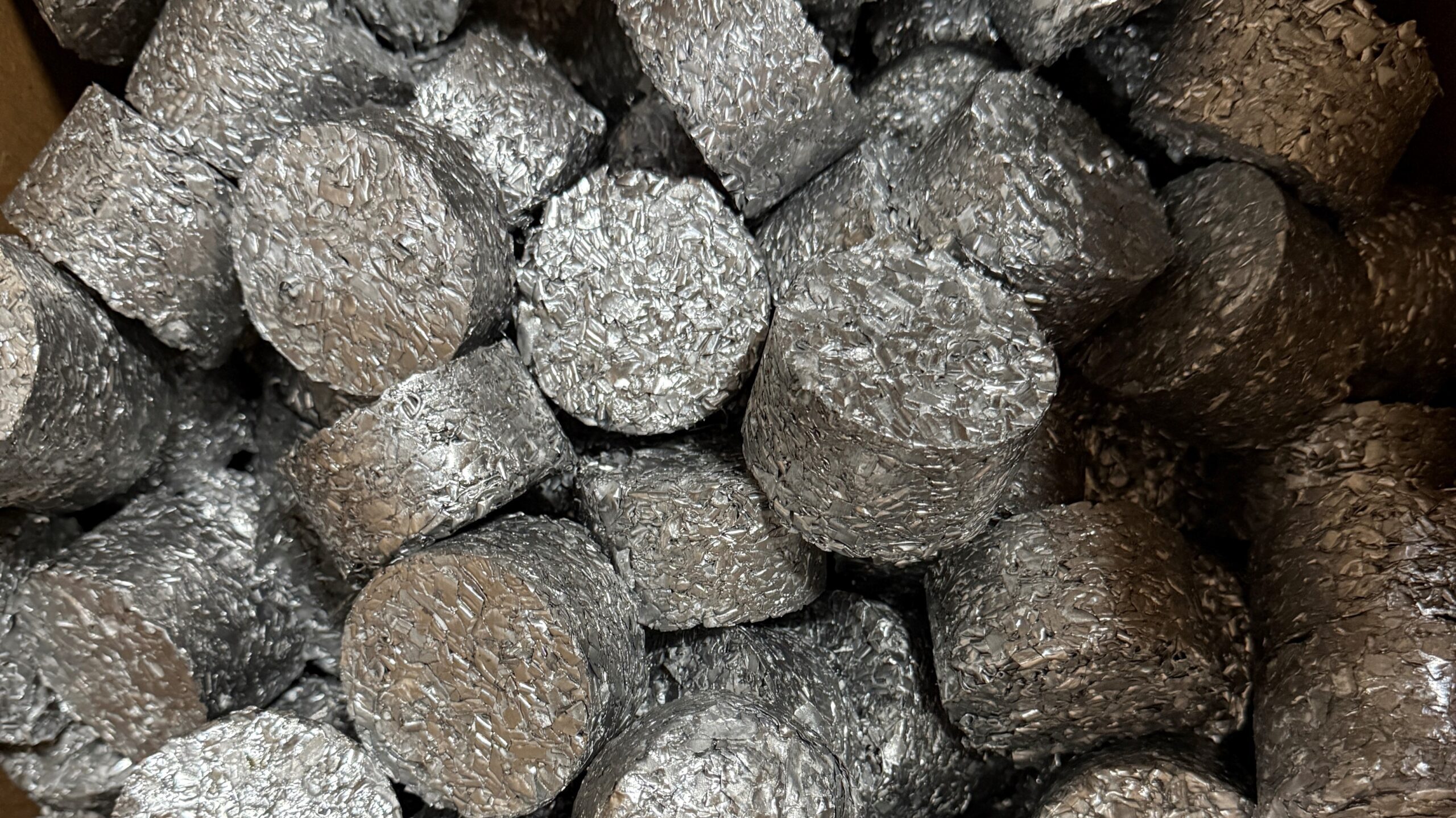
Compactors Turn Up The Volume For Effective Chip Management
July 13, 2026 11:43 amFeatured in Defense and Munitions.
The Growing Need for Chip Management
Chip management has come to the forefront in the aerospace and defense industries, among others. While the health and safety of employees, reclaiming coolant, and environmental consciousness are driving this need, the main contributor is the increase in lights-out automated production operations. Today’s machine tools deliver higher production output (more parts, faster) while allowing for unattended production. Shops must incorporate chip processing strategies to deal with significantly more chips and the lost coolant those chips carry with them.
Additionally, to ensure the dependability and consistency of critical components, manufacturers produce them from single solid pieces of raw material rather than mixing processes such as casting with finish machining. Doing so eliminates any material variation problems in castings and maintains finished part integrity. Unfortunately, it also generates huge volumes of chips.
In many cases, defense manufacturers machine away about 80% of raw workpiece material when producing parts. This amount is further compounded for those manufacturers running 24/7 part machining operations, which magnify the need for chip evacuation and management.
For one aerospace and defense company, the need for chip management stemmed from large volumes of chips, along with the costs associated with handling them and lost machine-tool coolant. Forklift drivers were required to transfer chips from the production floor to a dock area, and the company’s waste hauler refused to accept the chips for recycling if they had excessive amounts of coolant in them.
A Customized Chip Processing Solution
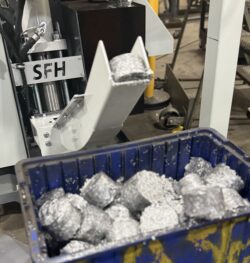
The solution was a Jorgensen-SFH custom chip processing system including bins, a hopper, and a shredder with a briquette compacting unit. The system accommodates the company’s chip bins of all sizes for two large multi-axis vertical machining centers and other machining cells, eliminating the need for forklifts and replacing them with carts easily moved to a tipper unit.
The tipper accepts the chip bins and dumps them into the hopper which handles two bins’ worth of chips at a time. The hopper, equipped with pushers, feeds the shredder, where they’re prepared for the compacting unit. Throughout this process, the system additionally recovers more of the cutting coolant from the chips, which is then returned to the machine tool tanks.
The company is one of the world’s leading designers and manufacturers of high-performance electrical and communications systems. Along with a vast product breadth, the company provides customers with higher levels of support in engineering and certification services for the commercial aerospace, military and defense electronics, industrial, test and measurement, and medical industries. The chip management system was for the company’s connector manufacturing operations.
Designed for Different Chip Geometries
A unique aspect of the Jorgensen-SFH system is the hydraulic pushers located inside the hoppers. The pushers accommodate various chip geometries and materials. The hydraulic pushers are customized per application for further automated chip handling. When a bin is dumped into the hopper, the pushers with specific geometric ends force the chips into the shredder, cutting them into smaller uniform pieces.
Pusher end geometries change per application, and the number of pushers is also tailored to the process. Designs are spear- or fork-shaped depending on the chip material, and this customization is key to maximizing shredder efficiency. Proper chip sizing is critical, as it directly impacts briquetting performance.
The Benefits of Briquetting
While most shops benefit from chip compacting, there are instances where compacting can lessen the value of chips for recycling. For example, titanium and Inconel chips lose some of their value if briquetted. This isn’t the case with aluminum, steel, and other common ferrous chips.
By briquetting these chips, shops also reduce their overall storage volume. Loose chips create spatial restraints depending on the shape and size, whereas shops save floor space when forming chips into briquettes. In some instances, chip volumes are reduced by a ratio of 9:1. This amount of savings carries over to less required truck space, thus lower handling costs to haul them to a recycler.
For many defense manufacturers, the main motivations to incorporate chip processing are easier chip handling, less chip storage volume, and better coolant recovery. Before being compacted, chips were upward of 20% moisture – an amount the waste hauler refused to take. For optimal coolant recovery, centrifugal chip wringers can dry chips to a moisture content of 4% or less. This percentage is even further reduced in the briquetting process.
Centralized Chip Processing Systems
Smaller-sized briquetters allow shops to feed their machine tool chip conveyor directly into them for compacting. However, for defense manufacturers with more than 10 machine tools, a larger centralized system more efficiently handles the larger volumes of chips. Outfitting each machine with its own compactor in those instances would be cost-prohibitive.
Many defense shops these days want absolutely no chips stored in their facilities. This eliminates the need for storage and frees up the space for production. In those instances, Jorgensen-SFH replaces the larger chip bin with a small hopper and feed system, sometimes including a shredder, with vacuum capability. Essentially, a centralized vacuum sucks and transports the chips up to 1,000ft along a pneumatic vacuum conveyor moving them into larger chips bins or compactors.
To eliminate the manual labor of moving chips from machines to the compacting system, Jorgensen-SFH can also apply autonomous mobile robots (AMRs) to transport them. In other applications, shops will use hinged steel belt conveyors to transport chips from machines to the centralized compacting system. Centralized systems allow for effective chip handling in lights-out production environments.
The Future of Chip Management
European defense manufacturers have been struggling with chips for decades, and there are many systems more than 30 years old still in use. In the U.S., however, briquetting, for the most part, has been popular, mainly because of chip size and volume. Lately, more aerospace and defense companies are establishing closed-loop networks with recyclers and foundries to further increase the efficiency of their chip management operations.
In all manufacturing sectors, the necessity for better chip management continues to grow. Advanced chip shredding, wringing, and briquetting systems are an ideal solution. They allow these manufacturers to efficiently handle large volumes of chips while reducing costs through machine-tool coolant recovery and increased chip recycling value.
Categorised in: Uncategorized






Comments are closed here.